
Gutters are the least glamorous part of a house and the most expensive to ignore. They only have one job — move water away from the building — and when they stop doing it, the damage shows up somewhere far more costly than the gutter itself.
In Kent, that failure has a season. Here's when to book, what to look for, and what you should expect from a thorough job.
Why autumn is the pinch point
Gutters fill gradually all year — moss washing down off the roof, grit from the tiles, seeds and blossom in spring — but it's autumn leaf fall that turns a partly-full gutter into a blocked one. The first heavy rain afterwards is when most people discover the problem, usually because water is sheeting over the front of the gutter instead of running to the downpipe.
That timing creates a squeeze. Demand concentrates into a short stretch of the year, and the weather that exposes the problem is the same weather that makes the work slower to schedule. Getting into the diary ahead of the rush is the difference between a planned visit and an emergency call-out.
When to get it done
In the UK the bulk of deciduous leaf fall runs from late October into November, so the clean itself is best done once that's largely finished — late autumn, before sustained winter rain sets in. Clear too early and you'll be doing it again in a month.
The part worth doing early is getting into the diary. Standard bookings usually go in within three to seven days, but that stretches once the first storms arrive and everyone calls at once. A call in September or early October means the job lands at the right time rather than whenever there's a gap.
If your property has few or no overhanging trees, timing matters less — the debris is grit, moss and wind-blown material rather than leaf fall, and it accumulates steadily rather than all at once.
How often do gutters actually need doing?
Once a year suits most homes. Two visits a year — typically autumn and spring — makes sense if any of the following apply:
- Mature trees overhanging or close to the roofline, especially deciduous ones
- A coastal or exposed position, where wind carries debris onto the roof year-round — common across Sheerness and the Isle of Sheppey
- A north-facing roof or a damp, shaded aspect, where moss grows faster and washes into the gutters
- Shallow or older gutter runs that hold water and silt up quickly
- A recent history of overflow, damp patches or blocked downpipes
The warning signs worth acting on
You rarely need a ladder to spot a gutter problem. Most of the tell-tale signs are visible from the ground, and catching them early is the whole point:
- Water spilling over the edge of the gutter during heavy rain, rather than running along it
- Plants, grass or weeds visibly growing out of the gutter line
- Dark staining running down the fascia, render or brickwork underneath a joint
- Damp patches appearing on interior walls near the eaves, or in ceiling corners
- Gutters visibly sagging or pulling away from the fascia — usually the weight of trapped water and debris
- A downpipe that stays silent in heavy rain while the gutter above it overflows
Any one of these is worth a look. Two or more together usually means the run is properly blocked rather than just dirty.
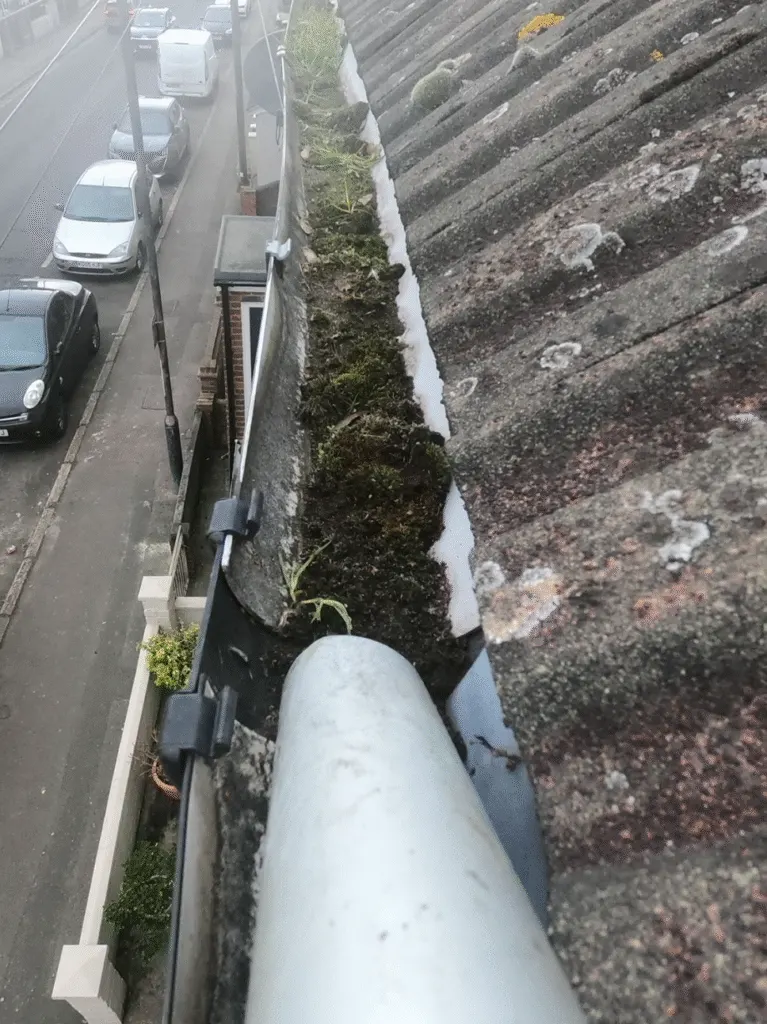
What a proper gutter clean includes
"Gutter cleaning" covers a wide range of thoroughness, and the difference matters. A job worth paying for clears the whole system, not just the visible front run:
- The full gutter run cleared — front and back, not just the elevation you can see from the road
- Downpipes and valleys checked and cleared, since a clean gutter feeding a blocked downpipe still overflows
- All debris removed from site, not tipped into a border or left on the lawn
- A camera inspection so you can see the result rather than take it on trust
- Before and after photos for your records
Our gutter cleaning service uses a vacuum system reaching up to 40ft, operated from the ground, with a wireless camera check on completion. Most three-bedroom semis are done in 45–60 minutes.
Why we work from the ground rather than up a ladder
A ladder resting directly on a gutter puts the load on the plastic run, or on the fascia behind it. On older uPVC that can be enough to crack a joint or pull a bracket loose — turning a maintenance visit into a repair.
Working from the ground avoids that question altogether, along with the safety considerations of working at height on soft ground in autumn. It also means the reach is the same whether the gutter is over a conservatory or above an extension.
What happens if you leave it
Overflowing gutters don't stay a gutter problem. Water running down the face of a building instead of into a drain finds its way into the fabric of the house, and the repair bill escalates the longer it runs:
- Staining and green algae growth down fascias, render and brickwork
- Damp patches internally around the eaves, then blown plaster and peeling paint
- Rot in fascia boards, soffits and roof timbers where water sits against them
- Standing water at the base of walls, which over time affects the foundations
- Birds, wasps and rodents nesting in the debris that's built up
Replacing a rotten fascia run is a far bigger job than clearing the gutter that caused it — which is why a yearly clean is one of the better-value pieces of property maintenance there is.
What varies across Kent
Conditions aren't uniform across the county. On the Isle of Sheppey and around the Swale, exposed coastal positions mean wind-blown debris arrives on roofs year-round and algae establishes quickly, so properties in Sheerness are among those worth checking twice a year rather than once.
Inland, shaded and north-facing roofs around Maidstone and the Medway towns hold damp for longer and grow moss faster — and that moss ends up in the gutters. Older properties across Faversham and Canterbury tend to have deeper roof valleys and more complex rooflines, which simply means more gutter run than the frontage suggests.